Pin Master - Nailed It!
- 3.9
- Rating
- 1.00M
- Installs
- Free
- Price
 Analysis by App-foxy
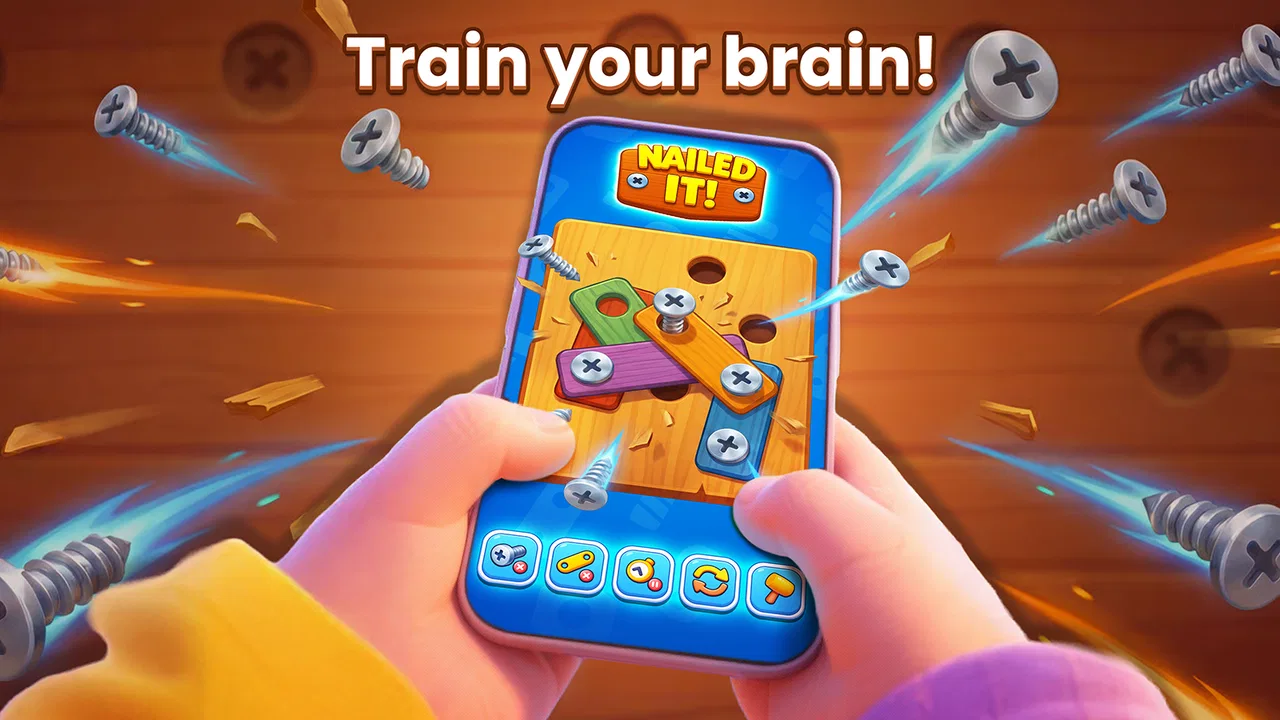
I approached Pin Master - Nailed It! expecting a quick puzzle to fill a few spare minutes, and that is exactly where it makes its strongest first impression. It is a free screw puzzle game from Gimica GmbH, built around the simple pleasure of working out which pin or screw should move next. The idea is easy to understand, but the order of actions matters, so even a small board can turn into a careful little planning exercise.
That combination makes it immediately approachable. I did not need a long tutorial or a complicated set of rules before starting. At the same time, the puzzles are not completely passive: I had to look at the arrangement, anticipate what would happen after a move, and avoid using an opening that would block the rest of the solution. For players who enjoy compact logic puzzles rather than story-heavy games, the basic appeal is clear.
The bigger question is whether that appeal survives after the novelty of moving pins wears off. A puzzle game can be enjoyable for an evening and still fail to become something I return to. In my experience, Pin Master has enough immediate clarity to earn a place in a casual rotation, but its long-term value depends heavily on how much variety and challenge you personally need from this type of game.
You May Also Like

 Blood Strike: 2.5 Anniversary
Blood Strike’s Loadouts Turn Every Drop Into a Tactical Gamble
A close look at Blood Strike’s custom loadouts: how fast access to signature weapons reshapes its battle royale rhythm, rewards preparation, and narrows the gap between fights.

 Pandora - Music & Podcasts
Pandora’s Music Is Easy to Start, but Harder to Recover
Pandora’s strength is its low-effort path from a seed to a station. Its weak spot is how much confidence it asks you to place in connection, setup, and quiet recovery.

 8 Ball Pool
 Is Built on Rivalries, Rematches, and Routine
A close look at the rivalries, rematches, shared routines, and unanswered safety questions that turn a quick pool match into a persistent mobile community.

 Samsung Music
’s Quiet Strength Is Playing What You Already Own
Its reach comes less from spectacle than from dependable access to a personal library. That simplicity is both the app’s strongest retention engine and its ceiling.

 AccuWeather: Weather Radar
AccuWeather Review: A Quick, Clear Forecast for Everyday Decisions
For everyday plans, the best forecast is the one you can understand quickly. AccuWeather makes rain timing, radar, and local conditions easy to act on, with a few trade-offs.

 Hill Climb Racing
Why Hill Climb Racing Still Turns Crashes Into One More Run
A tiny car, a bumpy hill and one more upgrade: Hill Climb Racing keeps resurfacing because its simple chaos makes every near-miss feel personal.
More From Our News Desk



Why the first week feels so accessible
The opening experience is built around a familiar puzzle rhythm: inspect the board, identify a safe move, and gradually free the pieces without creating an impossible arrangement. That makes each level feel like a small problem rather than a demanding session. I could play while waiting for an appointment, during a short break, or at the end of the day when I wanted something interactive but not mentally exhausting.
What I liked most during the first few sessions was the low barrier between intention and action. The game’s central interaction is easy to grasp, so my attention went toward solving instead of learning controls. This matters on a phone, where an overly delicate interface can make a simple puzzle irritating. Here, the appeal comes from the relationship between the visible layout and the consequences of each choice.
It is also a good fit for people who like tactile-feeling puzzle ideas without committing to a long campaign. You can pick it up, solve a small challenge, and put it down without needing to remember a plot or manage a large collection of systems. That makes it more convenient than many traditional puzzle games that expect longer concentration or introduce several mechanics at once.
However, the first-week experience is not equally strong for everyone. If you prefer puzzles with wordplay, deduction across several clues, or a clearly escalating strategic system, the screw-and-pin format may feel narrow. It concentrates on spatial order and careful removal, not on narrative discovery or broad mechanical experimentation. I would recommend it first to someone who enjoys visual problem-solving and short sessions, not to a player looking for a deep standalone brain-training suite.
Small decisions matter more than fast fingers
One useful way to approach the early levels is to stop treating the board like a list of objects to clear. I found better results by asking which move creates space, which piece is supported by another, and which opening could leave a crucial area inaccessible. That change in mindset is important: the game rewards planning rather than speed.
A practical routine helped me avoid careless restarts. I first scanned the entire arrangement, then selected a move that appeared to increase the number of available options. After that, I paused briefly before making the next choice instead of automatically repeating the same gesture. This is a small habit, but it turns the game from random tapping into a more satisfying sequence of decisions.
Another useful tip is to watch for moves that look productive only because they remove something immediately. Clearing one piece is not always progress if it exposes no new route or forces a later blockage. When I focused on preserving flexibility, I made fewer impulsive mistakes. That is the kind of lesson that gives the early game more substance than its simple presentation might suggest.
Who gets the most from the opening sessions
Pin Master works especially well for casual players who want a puzzle that can be understood in seconds and practiced over repeated short visits. It is also suitable for families looking for an accessible game, since its content rating is Everyone and the basic objective does not depend on specialized knowledge. Younger players may still need patience with planning, but there is no complicated fictional setting to decode before the puzzle begins.
I can also see it appealing to people who enjoy organizing tasks mentally. The board encourages you to separate what can be done now from what should be left untouched until later. That makes it a pleasant reset between more demanding activities. It is not a replacement for a full strategy game, but it can provide a compact moment of concentration without the commitment that strategy games often require.
On the other hand, players who dislike trial and error should approach it carefully. Even when the controls are clear, a wrong order can make a solution feel unavailable, and that can be frustrating if you want every attempt to be immediately recoverable. The game is better for someone who accepts that a failed sequence is part of solving than for someone who expects every move to be reversible or forgiving.
What remains useful after the novelty fades
After the first burst of curiosity, I judged the game less by its theme and more by whether it gave me a reason to return. The answer is mixed but positive. Its recurring value comes from the convenience of having a compact puzzle available whenever I want a mental break. I do not need to prepare for a session, remember a complicated objective, or invest a large block of time.
The game has reached over a million installs, with an average rating of 4.1 from around 37 thousand ratings. Those figures suggest that the straightforward format has found a sizeable audience, although popularity alone does not guarantee lasting personal value. For me, the important point is that the core loop remains understandable on every visit: inspect, plan, remove, and learn from the result.
That loop can become a useful habit when matched to the right moment. I found it more satisfying as a short transition activity than as an all-evening game. For example, someone might use it after commuting, before starting homework, or between household tasks. In those situations, the lack of a lengthy setup is a genuine strength. The game gives the mind one contained problem and then lets the player leave.
Its month-to-month appeal depends on how much repetition you tolerate. A player who enjoys refining the same kind of spatial reasoning may keep finding value in the format. Someone who needs new rules, changing objectives, or a strong sense of progression may eventually feel that the surface changes more slowly than the underlying activity. I would not choose it as my only puzzle game, but I can see it staying installed alongside other genres.
How it compares with familiar puzzle alternatives
Compared with match-three games, Pin Master asks for more deliberate sequencing and less rapid pattern clearing. Match-three titles often reward quick recognition and repeated combinations, while this game makes the order of removal the central concern. If you enjoy planning several steps ahead, Pin Master may feel more mentally focused. If you prefer constant visual motion and immediate rewards, a match-three alternative may hold your attention longer.
Compared with word puzzles, it offers a more visual and language-independent experience. I did not need vocabulary, trivia knowledge, or comfort with clues. That makes it easier to share across different ages and language backgrounds. The trade-off is that it cannot provide the same sense of discovery that comes from finding a clever phrase or interpreting an ambiguous clue.
Compared with physics-based puzzle games, its appeal is more about order than experimentation. Physics games often invite players to test unusual solutions and watch objects react. Pin Master is more controlled: the satisfaction comes from understanding the arrangement and making a clean sequence. Players who enjoy predictable consequences may prefer that structure, while those who love surprising chain reactions may find it restrained.
For a player seeking a deep puzzle platform with varied rule sets, another option will probably be stronger over the long term. For a player seeking a focused, low-commitment screw puzzle, this one has a clearer purpose. That distinction is important because the game succeeds by staying simple; asking it to provide the breadth of a large puzzle collection would be unfair, but expecting endless novelty would also be unrealistic.
Questions I would consider before keeping it installed
One practical question is whether it costs anything to start. The game is free to download and play, while optional in-app purchases range from $0.99 to $12.99 per item. I would treat those purchases as a convenience choice rather than part of the reason to try it. If you are comfortable enjoying a free puzzle at its natural pace, you can begin without making a financial commitment.
Another question is device compatibility. The game supports Android 7.0 and later, so it is not limited to only recent phones. The current version is 1.6.0, which is useful to know when checking whether an older device can run it. I would still judge the experience on your particular phone, especially if you are sensitive to touch accuracy or prefer playing on a larger screen.
Some readers may also wonder whether it is appropriate for children. The Everyone rating makes it broadly accessible, but age suitability does not remove the need for supervision around spending or screen time. The puzzle itself is easy to understand, yet younger players may need help learning to plan rather than repeatedly trying random moves.
The final question is whether it offers enough reason to return every day. I would not promise that for everyone. Its strength is dependable short-form play, not a dramatic long-term journey. If you enjoy making gradual improvements in visual planning, it can become a pleasant routine. If you need a strong narrative, social competition, or constantly changing mechanics, you will probably move on sooner.
The maintenance burden is low, but attention still matters
One reason I can imagine leaving Pin Master installed is that it asks very little from me between sessions. I do not have to maintain a large collection, remember a complicated build, or keep track of a story. The game’s compact format makes it easy to return after several days without feeling lost. That is valuable for a casual app because many mobile games become chores when they demand regular upkeep.
The maintenance burden is not completely absent, though. The main thing to manage is your own tolerance for repetition. If you play for too long in one sitting, the same basic decision pattern can start to feel mechanical. I got more enjoyment by treating it as a short activity and stopping when the solving process began to feel automatic. That preserves the sense of concentration instead of turning it into background tapping.
I also recommend separating genuine mistakes from impatience. When a board seems difficult, it is tempting to rush through several moves just to see what happens. That can make the game feel less fair than it is because the problem may have been created by an unexamined opening. Slowing down for a full visual scan is a better maintenance habit than blaming the puzzle after a careless sequence.
This is where the game earns some recurring value: it can train a modest but useful discipline of pausing before acting. I would not describe it as a complete cognitive training program, and I would not use it to make medical or educational claims. But as a small exercise in sequencing and spatial attention, it has a clear everyday role when used in moderation.
Where fatigue begins
The main source of fatigue is the narrowness of the central interaction. Moving pins and screws is satisfying when the arrangement feels fresh, but the theme alone cannot carry unlimited sessions. Once I understood the broad solving approach, I became more aware of whether a particular board offered a genuinely interesting decision or simply required the same process again.
There is also a risk of frustration when the correct order is not obvious. A puzzle can be challenging because it reveals a clever relationship, or it can feel difficult because one wrong early move ruins the attempt. The difference depends on how clearly the board communicates its logic. I enjoyed the former much more than the latter, so my opinion of a session could change quickly based on the quality of the individual arrangement.
Players who want a strong sense of accomplishment may eventually wish for more visible variety or a broader range of goals. I would skip this game if my priority were a richly evolving puzzle system. I would also skip it if I knew I was likely to play continuously for hours, because the format is better at delivering repeated small challenges than sustaining a marathon session.
That limitation does not make it a poor game; it defines the right use. Pin Master is most convincing as a reliable pocket puzzle, not as a single title expected to occupy all of a player’s gaming time. Choosing it with that expectation makes the simple design feel intentional rather than incomplete.
My long-term verdict
After looking beyond the first-week novelty, I think Pin Master - Nailed It! earns a place on a phone for the right kind of player. I like its direct controls, its emphasis on planning, and the fact that a session can fit into an ordinary day without demanding a major time investment. The developer, Gimica GmbH, has kept the central idea easy to approach, which is exactly why the game can work for casual puzzle fans and families.
I would recommend it to someone who wants a free visual logic game, enjoys thinking about move order, and is happy to play in short bursts. It is especially suitable if you prefer a calm, self-contained challenge over fast reactions or a complicated progression system. The Everyone rating also makes it broadly approachable, though spending choices and playtime are still worth managing for younger users.
I would not recommend relying on it as your only puzzle experience. Its recurring value is real but focused. Players who need wordplay, physics experiments, competitive features, or constantly shifting mechanics will likely find a better match elsewhere. Even fans of screw puzzles may tire of the format if they play too intensely, so the best strategy is to keep sessions purposeful and stop before the decisions become automatic.
For me, the lasting appeal is not the novelty of the nails themselves. It is the small pause before a move, the satisfaction of opening the board without closing off the solution, and the convenience of having that kind of problem ready whenever I need a break. That is enough to make it a worthwhile casual download. Just think of it as a compact puzzle habit rather than an endless game, and Pin Master is much more likely to keep its place after the first impression fades.
FAQs for Pin Master - Nailed It!
01What is Pin Master - Nailed It! about?
Pin Master - Nailed It! is a mobile puzzle game that challenges players to strategically pull pins to solve intricate puzzles. The goal is to guide various elements, like balls or liquids, to the correct destination, often navigating through obstacles and traps. It's designed to test your logic and problem-solving skills.
02Is Pin Master - Nailed It! free to play?
Yes, Pin Master - Nailed It! is free to download and play on both Android and iOS devices. However, it offers in-app purchases for additional features, hints, or to remove ads. These purchases are optional and designed to enhance the gameplay experience without being necessary to progress.
03What are the main features of Pin Master - Nailed It!?
The game features hundreds of challenging levels, each with unique puzzles to solve. It also includes vibrant graphics, smooth animations, and an intuitive interface that makes it easy to pick up and play. Additionally, players can enjoy daily challenges and earn rewards to unlock new levels and customization options.
04Are there any ads in Pin Master - Nailed It!?
Yes, the game includes ads, which are typically displayed between levels or when players opt for hints. These ads help keep the game free for users. However, players have the option to purchase an ad-free version through in-app purchases if they prefer an uninterrupted gaming experience.
05Can Pin Master - Nailed It! be played offline?
Pin Master - Nailed It! can be played offline, allowing users to enjoy the game without an internet connection. This makes it ideal for playing on-the-go or in areas with limited connectivity. However, certain features like in-app purchases and updates require an internet connection to access.
Pros
- Intuitive interface makes gameplay easy.
- Varied level designs keep it engaging.
- Smooth performance with no lag issues.
- Creative puzzles that challenge the mind.
- Regular updates with new content.
Cons
- Occasional ads can disrupt gameplay.
- Limited free levels without in-app purchases.
- Some levels feel repetitive over time.
- Requires internet connection to play.
- Graphics could be more polished.

Pin Master - Nailed It!
Gallery